The language of luxury furniture often begins with surfaces: oak, leather, powder coat, brushed metal. Those descriptions can be accurate and still tell you very little about the complete object. A useful assessment follows the load from the equipment to the top, through the fixings and frame, and finally to the floor.
Ask a manufacturer to describe the construction in plain terms. What is the desktop core? How are its edges finished? Which parts are structural, which are decorative, and which can be removed? A clear answer is more useful than an assertion that the furniture is handmade, aerospace-inspired or designed without compromise.
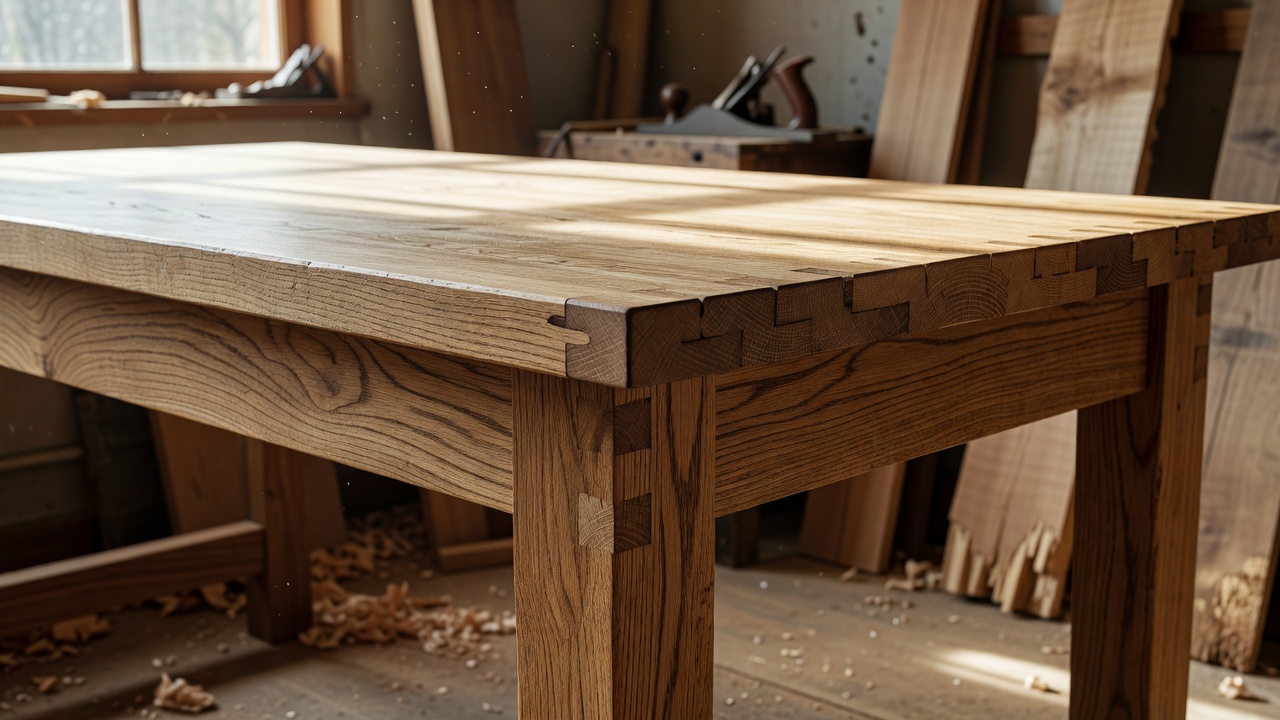
Separate material from construction
Solid timber can be repaired and refinished in many circumstances, but it responds to changes in moisture. The design must accommodate movement rather than restrain it carelessly. Look for an explanation of fastening methods, expected variation and room conditions. A natural split should not automatically be dismissed as character, nor should ordinary grain variation automatically be treated as a defect.
Veneer is a thin layer of timber over a substrate, not inherently a cheap imitation. A stable core and well-executed edging can make it appropriate for a large working surface. Its limitations matter too: aggressive sanding can cut through the face, and damaged edges may require specialist attention. Ask what is beneath the veneer and how repairs are handled.
Solid timber
Inspect movement allowances, fastening and finish repair instructions. Species alone does not establish performance.
Veneered panel
Ask about the core, edge protection and permitted refinishing. A convincing face is only one part of the build.
Read edges, joints and fixing points
Laminate and other engineered surfaces can offer consistent appearance and practical cleaning. Their durability depends on the full assembly, including edge adhesion and protection against moisture entering the core. Examine corners closely. Ask how a spill should be treated and whether a damaged panel can be replaced independently of the frame.
On furniture intended for repeated assembly, inspect threaded inserts and access to fasteners. A strong-looking bolt is useful only if the surrounding material and connection are appropriate. Check whether replacement hardware has an ordinary specification or must be purchased as a proprietary kit. Do not modify load-bearing joints merely because an alternative fixing seems stronger.
Judge metalwork beyond its weight
A heavy frame is not automatically rigid, and a smooth coating does not reveal the quality of every weld beneath it. Look for consistent alignment, stable contact with the floor and clean interfaces between parts. Ask which frame configuration has been tested and whether that includes the top size you plan to order.
Powder coating is a process, not a universal promise of scratch resistance. Preparation, coating formulation and use conditions all matter. Request care guidance for the exact finish. Likewise, polished or brushed metal can show fingerprints and small scratches differently in real daylight than under controlled product lighting.
The better question is not “Is this premium?” but “Can you explain how it is made?”
Ask for evidence with boundaries
Certification can answer a specific question without answering every question. FSC and PEFC claims concern forest-based material sourcing within their respective schemes; they do not guarantee furniture comfort or complete product durability. Verify the precise claim and its scope using the scheme's official resources, including the FSC certificate search and PEFC.
Similarly, a fabric tested using an abrasion method such as ISO 12947 provides evidence about a defined test, not a forecast of household service life. Seams, foam, cleaning products, sunlight and clothing all affect wear. Ask for the test method and result rather than comparing unexplained durability numbers across brochures.
Use samples to test expectations
View a finish sample in your own room beside the flooring and existing furniture. Turn it in daylight and under your evening lighting. Feel the edge and ask whether the sample represents the supplied construction or only the colour. Small samples cannot show the full range of timber grain or every variation in upholstery.
Finally, assess the maker's documentation. An understandable assembly manual, an itemised parts list and a specific response to a technical question are useful ownership signals. They are not guarantees, but they reduce uncertainty more effectively than a lifestyle photograph alone. Keep the replies with your order so the agreed specification remains clear.
Material choices become meaningful over time. Read how to plan for everyday wear before committing.